



Pneumatics › Solenoid / pneumatic directional control valves
Valve Manifolds & Valve Islands – Build Pneumatics Modularly
Several valves, one common pressure port, one set of wiring: valve manifolds and valve islands combine directional control valves on a single base plate and reduce tubing, installation space and assembly time. At STASTO you will find the complete chain – from the individual valve section and manifold base plates to the multipin or fieldbus valve island. Choose the suitable series or have your combination built, fully assembled and tested.
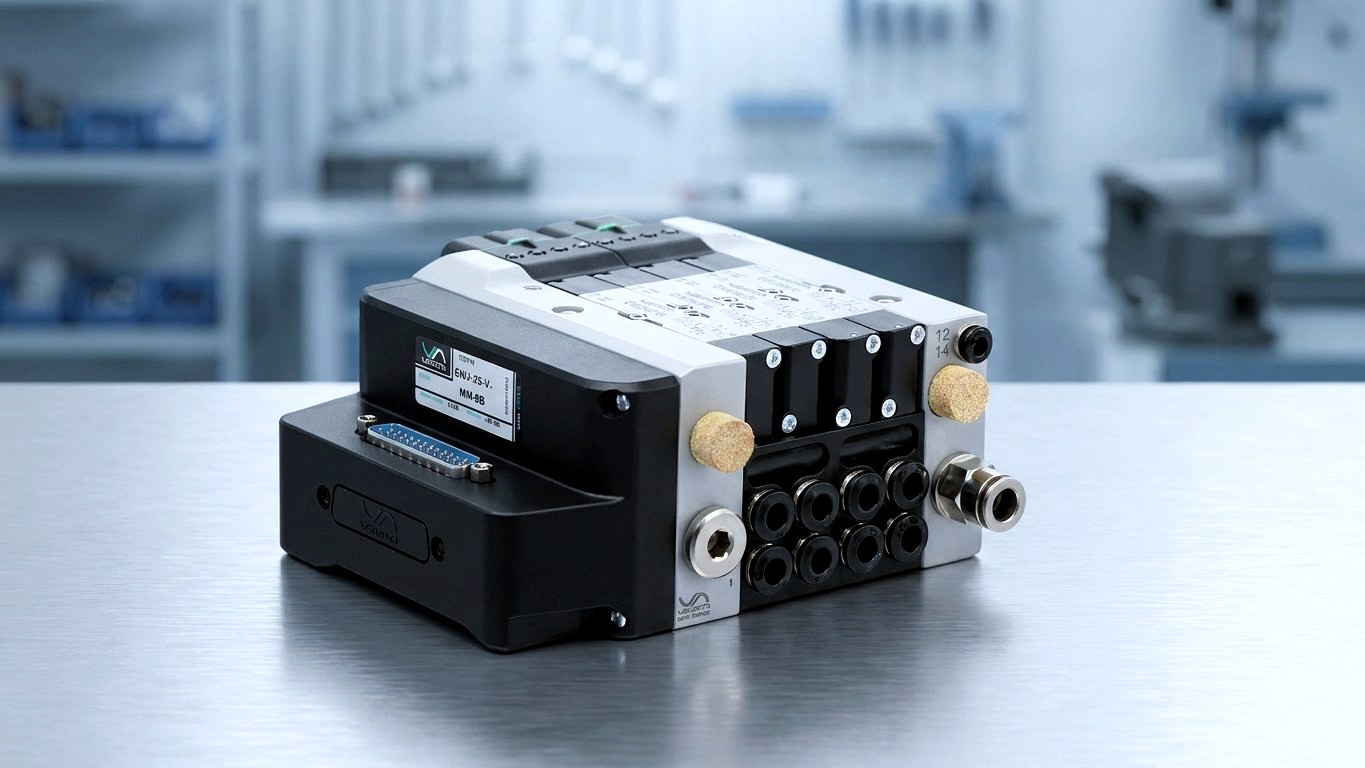
Series MPB · MPK · PS125-VU · MULTIPOL 4HF · FIELDBUS 4HFNL
Benefits
Why modular valve manifolds and valve islands
Instead of tubing and wiring each directional control valve individually, valve manifolds combine supply, exhaust and control. This shortens installation and makes expansions easy to plan.
One connection instead of many lines
The valves are mounted on a common manifold or base plate with central compressed air supply and shared exhaust. This saves fittings, tubing runs and sources of error in the control cabinet or directly on the machine.
Modularly expandable
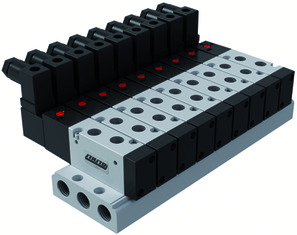
PS125-VU series valve manifolds can be expanded as required as manifold valves; K series connection plates are available for 2 to 16 valves. Spare positions on 4HF and 4HFNL series valve islands can be fitted with valves later.
Multipin or fieldbus – your choice of control
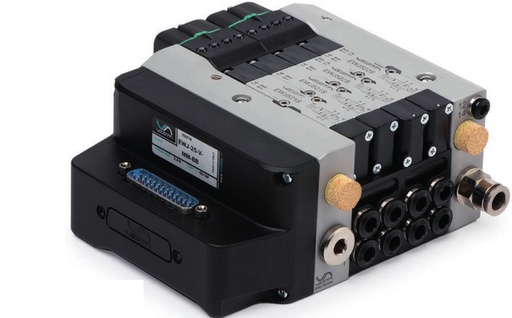
MULTIPOL valve manifolds of the 4HF series are controlled via a single SUB-D 25 multipin connector. FIELDBUS valve manifolds of the 4HFNL series are available in a Profibus version (DB9) and an Ethernet version, among others, complemented by expansion stations.
Fully assembled and tested
As a STASTO combination, we supply complete valve banks from 2-fold to 20-fold – including solenoid coils, connector plugs, fittings and silencers. You receive a tested unit instead of a parts list.
Guide
Valve sections, manifold base, valve manifold – this is how your configuration comes together
Valve count, function, size, flow rate and actuation determine the configuration. The following points guide you through the sizing process in the usual order.
Function, size and port pattern
- Valve function 3/2, 5/2, 5/3
- 3/2 for single-acting cylinders, vacuum and blow-off air, 5/2 monostable or bistable for double-acting cylinders, 5/3 with centre position, e.g. closed.
- Spare positions
- Planning spare valve positions from the start is usually cheaper than adding a second manifold later.
- 16 mm connector width (Series K)
- Determines the pitch and base plate series; Series K manifold connection plate for Series K5., K6. and K9. directional control valves.
- 22 mm connector width (Series E+V)
- Manifold assembly via the Series ME manifold connection plate; mounting kits for Series E are also available.
- ISO port pattern
- For 5/2 and 5/3 directional control valves with ISO port pattern, connection plates of the SBI-S and BMI series are suitable.
- Supply and exhaust ports
- On Series K, depending on the version, 1/4" or 3/8", valve size 1/8" or 1/4" – this is where the entire air volume converges.
Flow rate, actuation and accessories
- Flow rate per valve
- The stated flow rate applies per valve, not per manifold. When several valves switch simultaneously, the common supply port is the limiting factor.
- Example values
- 90 Nl/min for the PS125-VU series, 730 Nl/min for 5/2 directional control valves of the K5.W series – for specific values and pressure ranges, refer to the data of the selected variant.
- Individual wiring
- Up to roughly four to six valves, individual wiring with connectors remains cost-effective.
- Multipole and fieldbus
- Beyond that, multipole wiring via SUB-D-25 (4HF series) pays off; for fieldbus control or diagnostic requirements, the path leads to the 4HFNL series fieldbus valve island including expansion stations.
- Accessories
- Solenoid coils in the required voltage, connectors (optionally with LED and VDR), silencers, fittings and blanking plates for unused positions.
Comparison
Individual Wiring, MULTIPOL 4HF or FIELDBUS 4HFNL
The type of control determines wiring effort and diagnostic capability. The overview compares the three common approaches.
| Individual wiring | MULTIPOL Series 4HF | FIELDBUS Series 4HFNL | |
|---|---|---|---|
| Electrical interface | Connector socket per valve | SUB-D 25 multi-pin connector | Profibus (DB9) or Ethernet version |
| Typical application | Up to about four to six valves | Medium number of valves with central controller | Bus control, distributed valve groups, diagnostic requirements |
| Number of valves | Freely selectable by manifold base, e.g. 2 to 16 for Series K | Including 4-, 6-, 8-, 10-, 12-, 14- and 16-station | 4- to 16-station, expandable via expansion modules |
| Valve functions | Depending on the selected valve series 3/2, 5/2, 5/3 | 3/2, 5/2 monostable or bistable, 5/3 closed center | 5/2 monostable or bistable |
| Working ports | Depending on valve series, e.g. 1/8" or 1/4" | G1/8", 1/4" or 8 mm push-in | 1/8" or 8 mm |
| Expandability | Additional valve positions on the manifold base | Configurable spare valve positions | Spare positions, separate valve supply, expansion stations |
Product Range
Valve Manifolds and Valve Islands in the STASTO Range
From the overall category through the individual series to the subbase: start right here in the category that fits.
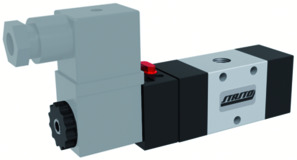
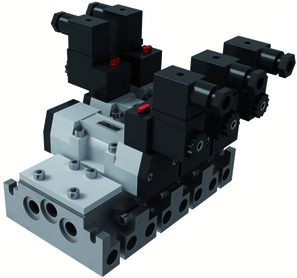
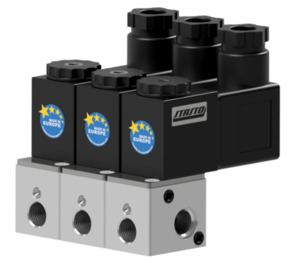
Applications
Where valve manifolds and valve terminals are used
Wherever many actuators have to be switched at the same time, a manifold assembly reduces tubing and wiring effort.
Machine building and special-purpose machinery
Many cylinder axes with short cycle times: a valve terminal with multipin or fieldbus connection replaces dozens of individual lines and keeps control cabinet wiring clear and manageable.
Packaging and handling technology
Compact 3/2 valve manifolds for suction grippers, pushers and diverters. Expandability matters more here than the flow rate of individual valves.
Testing and dosing technology
Many small nominal sizes packed closely together, e.g. with PS125 series manifold valves (1.2 mm nominal size) for precisely switchable individual channels.
Plant and control engineering
Pre-assembled valve manifolds with fittings and silencers reduce the effort in final assembly; spare stations keep options open for later system expansions.
Process valves with NAMUR mounting interface
If you actuate rotary actuators instead of cylinders, direct NAMUR mounting is the more suitable design – complementing the manifold assembly in the control cabinet.
Maintenance and retrofit
Manifold base plates and mounting kits allow individual valves to be replaced without rebuilding the entire assembly.
Procurement
Procurement: from bill of materials to tested unit
Valve manifolds are rarely standard catalogue items in the strict sense – the number of valves, function (3/2, 5/2, 5/3), voltage, port size and fittings determine the configuration. We quote your variant based on the series and assemble it in-house. Availability, price and delivery time depend on the series and equipment selected.

Availability and delivery time
Varies by variant and series – see the respective product page or available on request.
Technical values as per datasheet
Protection rating, pressure and temperature range depend on series and version, e.g. IP54 for individual 4HFNL versions. The data of the selected variant is decisive.
Special configurations on request
We clarify non-standard voltages, seal materials (e.g. FKM) and special fittings on an individual basis.
Assembled as a STASTO combination
Assembly including function test; valve mounting can be quoted per valve as a separate item – also onto an existing manifold.
Process
Three steps to a finished valve manifold
From enquiry to tested unit – this is how we process your configuration.
Describe your requirements
Number of valves, functions (3/2, 5/2, 5/3), voltage, port sizes and desired control – individual wiring, multipin or fieldbus.
Select the series and base plate
We assign your requirement to a series – MPB, MPK, PS125-VU, MULTIPOL 4HF or FIELDBUS 4HFNL – and select the matching manifold connection plate or base plate.
Assembly, testing, delivery
As a STASTO combination, we assemble the valve manifold including solenoid coils, connector plugs, fittings and silencers, and test it before delivery.
FAQ
Frequently asked questions about valve manifolds and valve islands
Short answers on designs, control methods and sizing.
What is a valve manifold?
A valve manifold is an arrangement of several directional control valves on a common manifold base plate with a central compressed-air supply and a shared exhaust. The valves are usually wired electrically one by one via connector sockets.
What is the difference between a valve manifold and a valve island?
A valve manifold consists of several valves on a common base plate, usually with individual electrical wiring. A valve island is the design with a shared electrical interface – multi-pin via SUB-D 25 (Series 4HF) or fieldbus (Series 4HFNL).
Multi-pin or fieldbus – which makes more sense?
Multi-pin via SUB-D 25 makes sense when the valves are controlled centrally by a single controller. Fieldbus is worthwhile when the controller already works over a bus, diagnostics are required or valve groups are distributed – the Series 4HFNL offers, among others, Profibus (DB9), an Ethernet version and expansion stations.
How many valves fit on a manifold base plate?
The Series K manifold base plate is available in versions for 2 to 16 valves. Valve islands of Series 4HF and 4HFNL are available, among others, in 4- to 16-station versions, and manifold valves of Series PS125-VU can be extended as required.
Does the stated flow rate apply to the entire manifold?
No, the stated flow rate applies per valve, not per manifold. When several valves switch simultaneously, the shared pressure port of the base plate is the limiting factor; example values from the range are 90 Nl/min for Series PS125-VU and 730 Nl/min for 5/2 directional control valves of Series K5.W.
Can I expand an existing valve manifold later?
Yes, provided spare stations are available or the series is designed to be expandable. Free valve stations on valve islands of Series 4HF and 4HFNL can be populated later; we quote valve mounting per valve as a separate item.
Which size fits my directional control valves?
The decisive factor is the connector width: 16 mm for the Series K, 22 mm for the Series E+V. This determines the base plate series – Series K manifold base plate or Series ME; for ISO directional control valves, the Series SBI-S and BMI base plates are suitable.
Does STASTO supply fully assembled valve manifolds?
Yes, as a STASTO combination we supply valve manifolds from 2-station to 20-station, fully assembled and function-tested. Included are, among other things, 24 V DC or 230 V AC solenoid coils, connector sockets, push-in or screw-in fittings and silencers.
Matching products
More series and manifold bases
Complementary categories for your configuration chain – from the larger series to the ISO subbase.
Next step
Configure your valve manifold
Go straight to the category or send us your requirements – we will specify the right series, valve configuration and control method.