



Pneumatics · Directional control valves electric / pneumatic
5/2 Way Valves – Pneumatic Solenoid Valves for Double-Acting Cylinders
The 5/2 way valve is the standard control element when a double-acting pneumatic cylinder needs to move in both directions: five ports, two switching positions, a defined transition between extend and retract. STASTO offers electrically and pneumatically pilot-operated 5/2 way valves in the PS110, PS111, PP110, PP111, K5.W, K5.P, E5. and V5 series, as well as NAMUR versions – from 1/8" to 1/2", with nominal sizes from 6 to 15 mm.
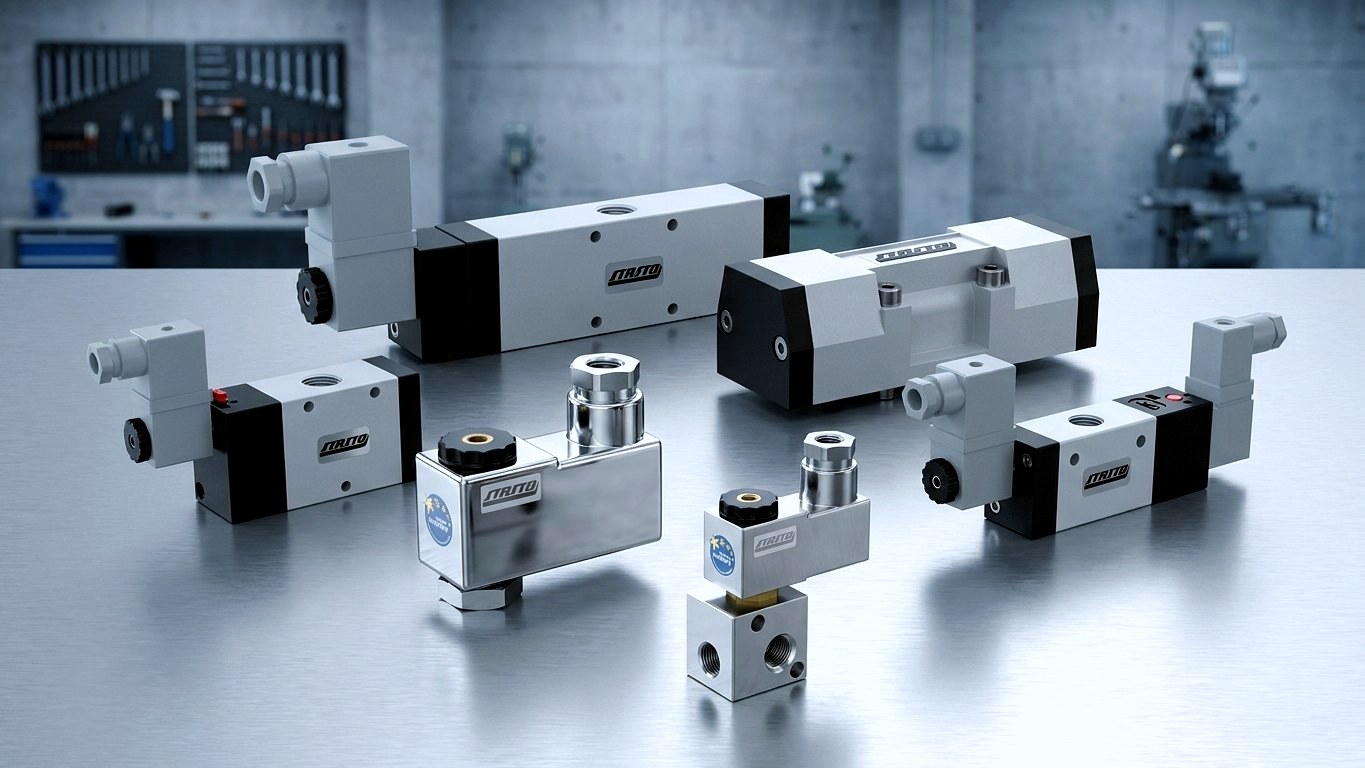
Design overview at a glance
Why STASTO
5/2-way valves from a consistent system
From the compact Series K with 16 mm connector width to ISO size 2: choose connection, port size, actuation type and coil within a single logic – without switching suppliers.
Consistent series selection instead of individual items
From the compact K5.W series with 16 mm connector width to ISO size 2 with 2200 Nl/min, we systematically cover small handling axes and large cylinder drives. Connection, port size and actuation type are selected within the same structure.
Monostable or bistable – clearly distinguished
Monostable versions (electric/spring) return to the default position on power loss. Bistable impulse valves (electric/electric) hold the last switched position. Both concepts are available within the same series.
Standardized interfaces: ISO 5599/1 and NAMUR
The PS110, PS111 and PS112 series are built to ISO 5599/1 in ISO 1 (DN 8 mm, 1080 Nl/min) and ISO 2 (DN 13 mm, 2200 Nl/min) and can be combined into valve manifolds via sub-bases (SBI-S, BMI) and blanking plates (PCBM). The NM series matches the NAMUR mounting pattern.
Coil, connector and accessories included in the selection
Standard coil C001 in 16 or 22 mm connector width, device connectors as standard or with LED and varistor (C002-31-6, C002-31-LV). Depending on the variant, coils with ATEX marking (type EPC) are listed – see the respective item variant for approval data.
Guide
Understanding the 5/2 way valve: function, designs, selection
Operating principle, differences from the 3/2 way valve and the key selection criteria – explained concisely for designing pneumatic control systems.
Function and port assignment
- Naming convention
- The designation follows the scheme "number of ports / number of switching positions": five ports, two switching positions.
- Ports
- One compressed air port (1/P), two working ports (2 and 4) to the cylinder, and two separate exhaust ports (3 and 5).
- Switching behavior
- In position 1, port 4 is pressurized and port 2 is exhausted; in position 2, this reverses.
- Separate exhaust
- Because each cylinder chamber has its own exhaust path, both directions of movement can be adjusted cleanly and independently using flow control valves.
3/2 or 5/2 – choosing the right design
- 3/2 way valve
- One working port: suitable for single-acting cylinders with spring return, vacuum suction cups, or as a shut-off valve.
- 5/2-way valve
- Two working ports: controls double-acting cylinders where both directions of travel are generated pneumatically.
- Rule of thumb
- If compressed air only extends the cylinder and a spring returns it, a 3/2 valve is sufficient. If compressed air moves it in both directions, 5/2 is the correct configuration.
Monostable, bistable and pilot control
- Monostable (electric/spring)
- Requires a continuous signal and returns to its default position on power loss – useful when a defined safe state must be reached.
- Bistable (electric/electric)
- Switches with a short pulse and retains its position even without power – useful for long hold times and to reduce coil heating.
- Minimum pilot pressure
- According to product data, bistable versions sometimes operate from a lower pilot pressure than monostable versions of the same series – check values per variant.
- Pilot control
- The listed series are pilot-operated; depending on the version, pilot air is supplied internally or externally.
5/3 variant with mid-position
- Mid-position closed
- Pneumatically locks the piston in place – for defined stops between the end positions.
- Mid-position exhausted
- Allows the axis to be moved by hand, e.g. for setup purposes.
- Mid-position pressurized
- Holds both cylinder chambers under pressure.
- Available series
- 5/3 versions are available in the PS112, PP112, K5.W, K5.P, E5. and V5. series.
Valve Types Compared
3/2, 5/2 and 5/3 compared
The three designs differ in the number of ports, cylinder type and behaviour in the rest or centre position.
| 3/2 | 5/2 | 5/3 | |
|---|---|---|---|
| Ports / switching positions | 3 ports, 2 positions | 5 ports, 2 positions | 5 ports, 3 positions |
| Typical actuator | Single-acting cylinder with spring return, vacuum suction cup | Double-acting cylinder | Double-acting cylinder with mid-stop |
| Working ports | One working port | Two working ports (2 and 4) | Two working ports plus mid-position |
| Mid-/normal position | Normal position open or closed | No mid-position | Blocked, exhausted, or pressurized |
| STASTO Series | Series K, Series E+V, NAMUR (Series NM) | PS110, PS111, PP110, PP111, K5.W, K5.P, E5., V5, NM | PS112, PP112, K5.W, K5.P, E5., V5 |
| Typical Application | Shut-off, vacuum, single-acting actuators | Standard motion control for handling and assembly | Positioning and defined stops |
Range
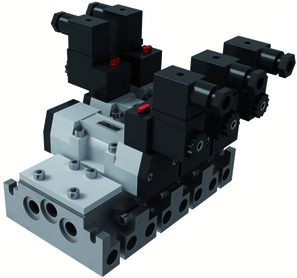
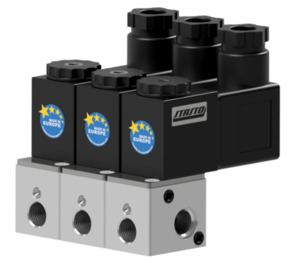
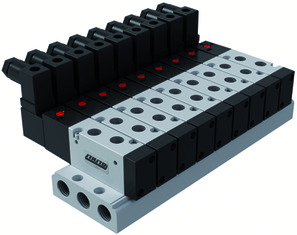
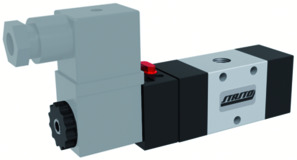
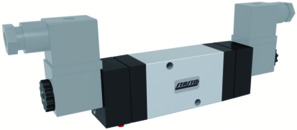
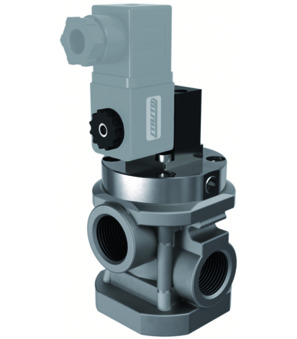
5/2- and 5/3-way valves in the STASTO range
Four valve series plus manually operated variants and matching accessories – structured by interface, connector width and actuation type.
Applications
Typical applications for 5/2 way solenoid valves
Where this valve type is used in practice – from handling axes to valve automation.
Double-acting cylinders in handling and assembly
The 5/2 way valve alternately applies pressure to cylinder chamber A or B and vents the opposite side. For short cycle times on small cylinders, port sizes of 6 to 8 mm from Series K5.W or E5 are sufficient; large strokes require ISO size 2 or the 1/2" version with 3500 Nl/min.
Valve manifolds and central control cabinets
Using sub-bases (Series SBI-S, BMI) and end plates (Series PCBM), ISO valves can be combined into valve manifolds. This reduces piping and makes the control setup easy to document and trace.
Valve automation with NAMUR mounting
With pneumatic quarter-turn actuators, Series NM eliminates external piping: the valve mounts directly on the standardized NAMUR interface. The 5/2 version controls double-acting actuators, the 3/2 version single-acting actuators with spring return.
Pneumatic control chains without electrical signals
Where no electrical actuation is planned, pneumatically pilot-operated 5/2 way valves from Series PP110, PP111 or K5.P take over the function. Signal generators are then push-button, roller, or foot valves.
Positioning and defined stops with 5/3
If a cylinder needs to stop between its end positions, a 5/3-way valve is used: closed centre position holds the piston firmly, exhausted centre position allows the axis to be moved by hand, pressurized centre position keeps both chambers under pressure.
Cycle and closing movements in filling and packaging lines
Short, recurring cylinder movements at sealing and transport stations are switched via compact 5/2-way valves of Series K with 16 mm connector width. Bistable impulse valves hold their position even without power.
Availability
Availability, Configuration and Delivery
The 5/2 and 5/3-way valves are listed as configured items: valve body, solenoid coil and connector combine to form the orderable variant. Availability and lead time depend on series and variant – we'll confirm the current status for your desired configuration on request.

Transparent variant configuration
The orderable variant is made up of valve body, coil voltage (incl. 24 V DC / 48 V, 230 V 50–60 Hz) and connector type – standard or with LED and varistor.
Standard combinations sourced faster
Common combinations from the K5.W and E5. series can typically be sourced faster than special configurations with ATEX-rated coils or non-standard mounting positions.
Accessories matched to each series
Silencers, mounting plates (SBI-S, BMI) and blanking plates (PCBM) are assigned to their respective series and can be requested together.
Quotation with datasheet
Quotation with datasheet and dimensional drawing on request. Special versions, valve combinations and blanket orders for recurring demand available on request.
Our approach
Three steps to the right 5/2-way valve
From your cylinder's key specs to an order-ready variant including coil and connector.
Describe the application
Specify cylinder volume, desired cycle time, line lengths and control voltage. This determines nominal size, port size and flow requirement.
Define design and series
Monostable or bistable, 5/2 or 5/3 with mid-position, ISO 5599/1, Series K with 16 mm or Series E+V with 22 mm connector width, alternatively NAMUR mounting.
Configure variant and request a quote
Combine valve body, coil and connector into an order-ready variant. We send the datasheet, dimensional drawing and quotation with availability information.
Frequently Asked Questions
Questions about 5/2-way valves
Function, differences and selection – the key answers at a glance.
What is a 5/2-way valve?
A 5/2-way valve is a pneumatic directional control valve with five ports and two switching positions that actuates double-acting cylinders in both directions. It has one compressed air supply port (1/P), two working ports (2 and 4), and two separate exhaust ports (3 and 5).
How does a 5/2-way valve work?
In one switching position, port 4 is pressurised while port 2 is exhausted; in the other position, this reverses. Because each cylinder chamber has its own exhaust path, the speed of both movement directions can be adjusted independently using flow control valves (throttle check valves).
What is the difference between a 3/2-way valve and a 5/2-way valve?
A 3/2-way valve has one working port and controls single-acting cylinders with spring return, vacuum suction cups, or shut-off functions. A 5/2-way valve has two working ports and controls double-acting cylinders, where both movement directions are generated pneumatically.
When do I need a 5/3-way valve instead of a 5/2-way valve?
A 5/3-way valve is used when the cylinder needs to stop between end positions. Depending on the version, the mid-position is either blocked (piston held pneumatically), exhausted (axis can be moved by hand), or pressurised (both chambers under pressure). Available in series PS112, PP112, K5.W, K5.P, E5. and V5.
What is the difference between monostable and bistable 5/2-way valves?
Monostable valves (electric/spring) require a continuous signal and return to their default position on power loss. Bistable impulse valves (electric/electric) switch with a short pulse and hold their position even without power – advantageous for long hold times and lower coil heating.
What does ISO 5599/1 mean for 5/2-way valves?
ISO 5599/1 defines standardized porting patterns and sizes for pilot-operated directional control valves. At STASTO, the PS110, PS111 and PS112 series are available in ISO 1 (DN 8 mm, 1080 Nl/min) and ISO 2 (DN 13 mm, 2200 Nl/min), and can be combined into valve manifolds using sub-bases and end plates.
What is a 5/2-way valve with NAMUR interface used for?
NAMUR valves are mounted directly onto the standardized interface of pneumatic rotary and linear actuators on valves, eliminating the need for external piping. The 5/2 version of the NM series controls double-acting actuators, while the 3/2 version controls single-acting, spring-return actuators.
What connection sizes and flow rates are available?
STASTO's 5/2-way valves range from 1/8" to 1/2" with nominal sizes from 6 to 15 mm. The K series typically delivers 1300 Nl/min at 1/4" and DN 8 mm, the ISO series 1080 to 2200 Nl/min, and the E+V series up to 3500 Nl/min.
Related Products
Complementary components for valve control
A properly functioning axis requires speed control, clean control air and mechanical signal transmitters.
Next step
Find the right 5/2-way valve
Browse our range or send us your axis specifications – we'll identify the nominal size, series and matching coil/connector combination.