








Solenoid Valves for Liquids and Gases
Solenoid valves that switch exactly when it matters.
Finding the right solenoid valve comes down to three specifications: media, control type and coil. 2/2- and 3/2-way solenoid valves, direct-, pilot- and force-pilot-operated, with solenoid coils for DC and AC plus matching connector plugs – a large part of the range is stocked.

Selection in Three Steps
Why STASTO
The right valve determines your system's performance.
A solenoid valve opens or closes a line electrically – via a solenoid coil that moves an armature against spring and media pressure. Whether it works reliably in your system comes down to four factors: media (and thus body material and seal), control type, required pressure differential and flow capacity, plus the coil's voltage, duty cycle and protection rating.
For every media
Compressed air, water, oil, neutral gases, steam and aggressive media. We select the body material (e.g. brass, stainless steel) and seal (e.g. NBR, EPDM, FKM, PTFE) to match the media and temperature – the most common cause of valve failure is an unsuitable seal, not the valve itself.
Every control type
Direct-acting switches from 0 bar and suits small nominal sizes and vacuum. Pilot-operated (servo/diaphragm-actuated) delivers high flow rates but requires a minimum differential pressure. Force-pilot-operated combines both: large port size, switching even without differential pressure.
Matching coil & voltage
Solenoid coils for DC and AC voltage (e.g. 24 V DC, 230 V AC), matched to duty cycle and ambient conditions; plus DIN connectors in common designs with protection rating specified when mounted. Coils are also available individually as spare parts.
From stock instead of plant downtime
A large share of standard series, replacement coils and connectors is kept in stock and available at short notice. Special versions, alternative materials and voltages are clarified during project consultation.
Selection guide
Understanding solenoid valves: flow function, control type, coil.
Key terms around solenoid valves in plain language – so you can read datasheets with confidence and find the right series faster.
Control types
- Direct-acting
- The solenoid plunger opens the seat directly. Switches from 0 bar, so it also works with no pressure or under vacuum – though flow capacity is limited.
- Pilot-operated (servo/diaphragm-controlled)
- The plunger only opens a small pilot orifice, the media pressure does the rest. High flow rates with a small coil, requires a minimum differential pressure.
- Force-operated
- Plunger and diaphragm are mechanically linked. High flow and switching even without differential pressure or with fluctuating pressure.
- Rule of thumb
- Small flow or no pressure → direct-acting; high flow with reliable pressure → pilot-operated; high flow without reliable pressure → force-operated.
Flow function & switching position
- 2/2-way
- One inlet and one outlet, acting as a shut-off valve: open or closed.
- 3/2-way
- Additional exhaust or return port: pressurise or relieve actuators – e.g. single-acting cylinders and positioners.
- NC – normally closed
- Without power, the spring keeps the valve closed. Reliable shut-off in the event of a power failure, e.g. water or gas supply.
- NO – normally open
- Normally open, closed when energized. Useful when a circuit needs to remain open during a power outage, e.g. cooling or pressure relief.
Coil, connector, materials
- Voltage
- Common voltages are 24 V DC and 230 V AC, along with 12 V DC, 48 V or 110 V – choose to match your control system.
- Duty cycle (ED)
- Valves that remain energized continuously need a coil rated for 100% duty cycle.
- Connector (EN 175301-803) & protection rating
- The protection rating (typically IP65) only applies with a correctly mounted and screwed-down connector plug including gasket; versions with wiring are available e.g. with LED indicator or surge suppression.
- Seal & body material
- NBR for water, air, mineral oil; EPDM for hot water, steam and aqueous chemicals; FKM for oils and higher temperatures; PTFE for aggressive media. Brass as standard, stainless steel for corrosion resistance or food contact.
Direct-acting, pilot-operated, or force-pilot-operated
Comparing control types.
The pilot control type determines whether a solenoid valve can also switch pressureless and what flow rate it achieves.
| direct-acting | pilot-operated | force-pilot-operated | |
|---|---|---|---|
| Switching from 0 bar / pressureless | yes, even under vacuum | no, minimum differential pressure required | yes, even with fluctuating pressure |
| Flow rate / cross-section | limited, small nominal sizes | high with compact coil | high |
| Operating principle | Armature opens the seat directly | Armature opens pilot bore, media pressure switches the valve | Armature opens diaphragm mechanically with |
| Typical application | Dosing, analysis, small volumes | Water and air circuits with safe pressure | pressureless start, varying pressure conditions |
| Category (2/2-way) | 2/2-way direct-acting | 2/2-way pilot-operated | 2/2-way force-pilot-operated |
Product range
Find your series.
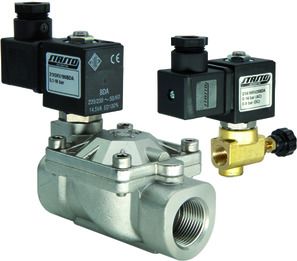
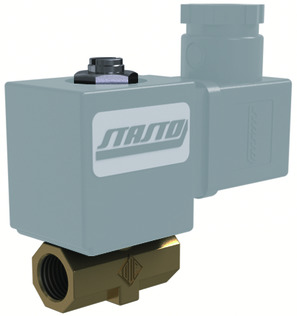
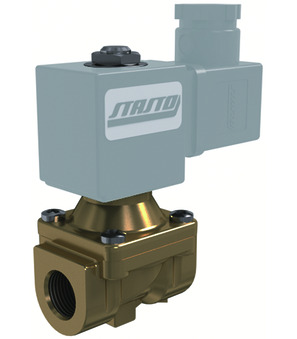
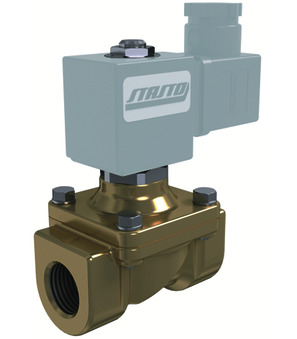
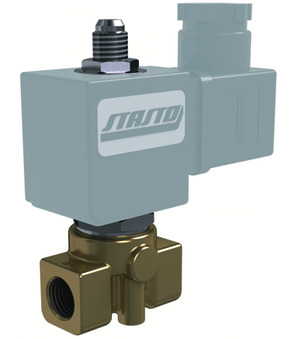
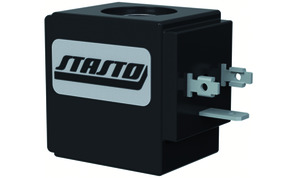
Solenoid valves for liquids and gases – sorted by way function and control type, plus coils and DIN connectors.
Application Areas
Wherever media need to be controlled.
From dosing systems to mobile machinery: solenoid valves switch air, water, oil, gases, and steam – the deciding factors are medium, pressure, and material.
Machine & Plant Engineering
Controlling air, water, coolant, and hydraulic media in machines, equipment, and cooling circuits.
Process Engineering
Dosing, shut-off, flushing and cycling in process and dosing systems; often direct-acting due to small flow rates and low pressures.
Food & Water
Drinking water, cleaning and filling processes with media-compatible materials and seals; material certification available on request.
Chemical & Process Industry
Aggressive media handled with resistant body materials and seals; selection based on medium, concentration and temperature.
Compressed Air & Steam
Switching compressed air in pneumatics as well as steam in cleaning and heating processes; temperature limits and seal material are key here.
Mobile Machinery
Rugged valves and solenoid coils for vehicle, attachment and commercial vehicle technology, designed for vibration, moisture and on-board voltage.
How It Works
Three steps to the right solenoid valve.
From the application through valve and coil to delivery – this is how you quickly find the right series.
Define the application
Determine medium and temperature, operating and differential pressure, required flow rate, connection size and switching function (NC or NO).
Select valve & coil
Determine the way function and control type, select body material and seal to suit the medium, then add coil (voltage, duty cycle, protection rating) and connector.
Ship from Stock
Stocked product series ship out on short notice; special materials, non-standard voltages, and custom versions available on request.
Frequently Asked Questions
Which medium do you need to switch?
Answers on actuation type, way function, switching position, coil, material and nominal size.
Direct-acting, pilot-operated or force-pilot-operated – which one do I need?
Rule of thumb: low flow or no pressure → direct-acting; high flow with reliable pressure → pilot-operated; high flow without reliable pressure → force-pilot-operated. Direct-acting solenoid valves open the seat directly via the armature and switch from 0 bar, meaning they also work pressureless and under vacuum, but their flow capacity is limited. Pilot-operated (servo- or diaphragm-operated) valves use the media pressure: the armature only opens a small pilot bore, and the pressure differential does the rest – this delivers high flow rates with a small coil, but requires the minimum pressure differential between inlet and outlet stated in the datasheet. Force-pilot-operated valves mechanically couple the armature and diaphragm, so they switch even without a pressure differential while still providing high flow.
What's the difference between 2/2-way and 3/2-way?
A 2/2-way solenoid valve has an inlet and outlet and works as a shut-off valve: open or closed. A 3/2-way valve additionally has a vent or return port and can either pressurize or relieve the actuator. The first number indicates the ports, the second the switching positions. 3/2-way valves are typical for single-acting cylinders, pneumatic rotary actuators and the pilot control of larger process valves.
What do normally closed (NC) and normally open (NO) mean?
NC (normally closed) means the spring holds the valve closed when de-energized; only applying voltage opens it. NO (normally open) is the opposite – open when de-energized, closed when energized. The decisive factor is the safe position in case of power failure: if the line must seal on power loss (e.g. water or gas supply), choose NC; if a circuit must stay open (e.g. cooling, pressure relief), choose NO. For valves that are mostly open, the matching function also saves continuous coil heating and energy.
Which coil, voltage and protection class do I need?
The coil must match the control system: common options are 24 V DC and 230 V AC, plus 12 V DC, 48 V or 110 V among others. Also check the duty cycle – valves that remain energized continuously need a coil rated for 100% duty cycle. The protection class (typically IP65) only applies with a correctly mounted and screwed connector including the seal. Connectors are available with additional circuitry (e.g. LED indicator, surge suppression), which is useful for electronic controls and long cable runs. Coils and connectors are available separately as spare parts – a faulty valve rarely needs to be replaced completely.
Which material and seal are suitable for my media?
Rough guideline: NBR for water, air and mineral oil at moderate temperatures, EPDM for hot water, steam and many aqueous chemicals (not for mineral oil), FKM for oils, fuels and higher temperatures, PTFE for aggressive media. For the body, brass is standard for water and air, while stainless steel is the choice for corrosion, food contact or cleaning media. What matters most is always the medium, concentration, temperature and cleaning procedure – give us these four details and we'll check the resistance based on the manufacturer's datasheet.
How do I choose the correct nominal size and connection size?
Not based on the pipe size, but on the required flow rate and the permissible pressure drop – the decisive factor is the valve's Kv value, not the thread size. An oversized valve costs more and, in pilot-operated designs, may switch imprecisely, while an undersized valve causes pressure loss and heat build-up. Also check the installation position, permissible operating pressure, switching frequency and, for liquids, the flow direction, which is fixed for solenoid valves. If several channels need to be switched, it's worth looking at solenoid valve manifolds and islands.
You Might Also Need
Related Categories
More valve types, spare parts, and centralized switching solutions for solenoid valves.
Availability
In Stock, When Speed Matters
A failed valve or a burnt-out coil can shut down an entire line fast. That's why we keep a large share of our standard product series, along with replacement coils and connectors, in stock and ready to ship.

Standard series ex stock
A large proportion of 2/2-way and 3/2-way solenoid valves are stocked and available for short-term delivery.
Spare parts available separately
Solenoid coils and DIN connectors are available separately – a faulty valve rarely needs to be replaced completely.
Special versions
We clarify deviating materials, seals and voltages during project consultation; lead time on request depending on variant and series.
Sizing included
Tell us the media, temperature, pressures, flow rate and control voltage – we'll tell you the series, coil and connector.
Consultation
Not sure about medium, pressure or coil? Let's size it together.
Send us the medium, temperature, operating and differential pressure, flow rate, connection and control voltage – we'll recommend the right series including coil and connector, plus availability.